
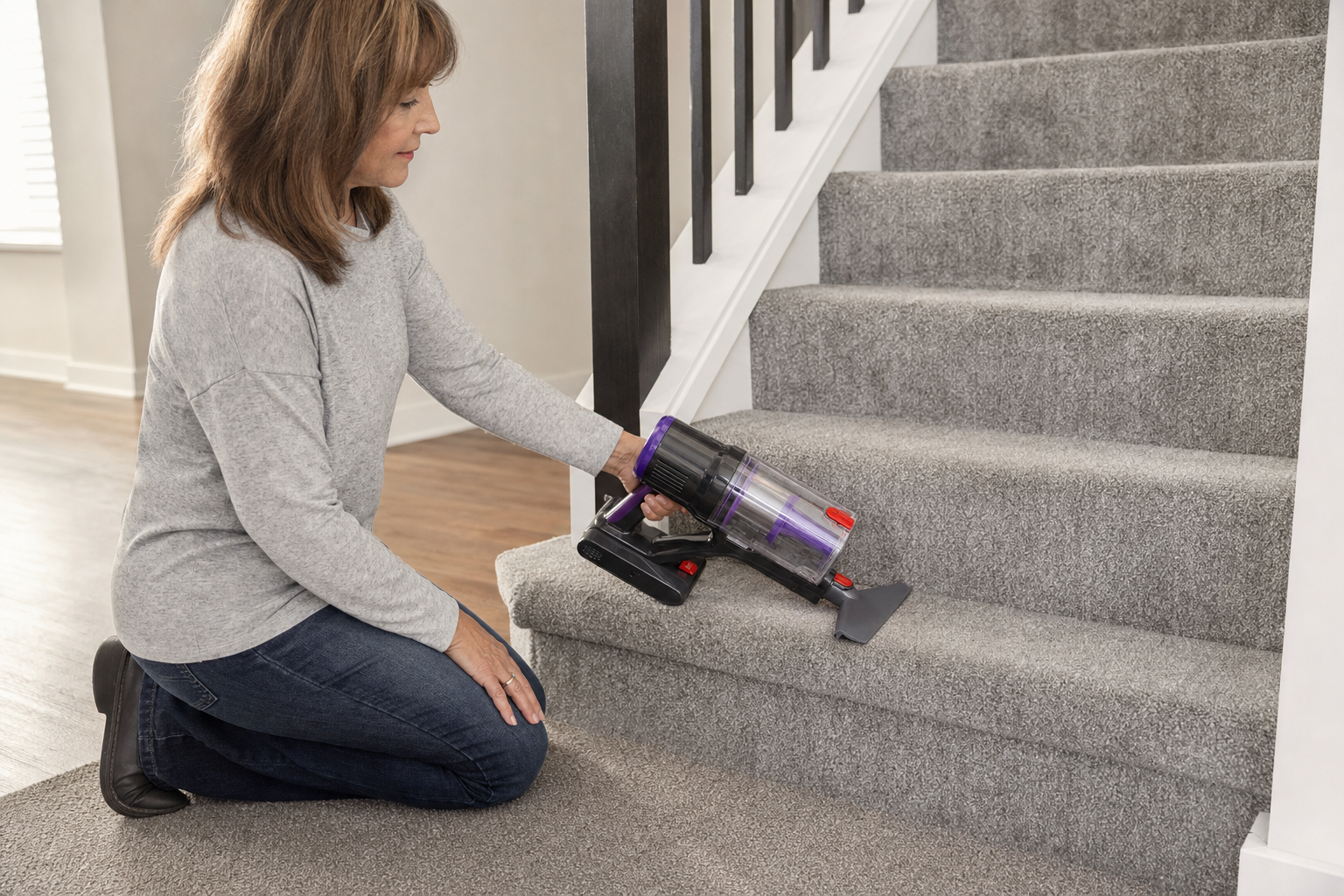
Learning how to vacuum stairs safely is less about speed and more about control. A clear route, stable position and suitable attachment make the job easier to manage one step at a time.
Stairs collect dust, hair and grit on the treads, along the edges and in the seam where each tread meets the riser. These areas are easy to miss, but trying to reach several steps at once can create unnecessary strain or leave the vacuum awkwardly balanced.
This guide covers a practical method for carpeted and hard stairs. Always follow the vacuum manufacturer's instructions and the care advice for the stair surface, particularly when using a powered brush, a new attachment or any tool on delicate carpet or timber.
Why Stairs Need a Different Cleaning Method
A flat room lets you walk behind the floor head in a straight line. A staircase is narrower, changes height with every step and often has corners that a full-size floor head cannot reach comfortably.
The safest approach is to reduce the amount you carry, keep the vacuum close to your body and work only within a comfortable reach. Do not balance a vacuum on the edge of a tread or pull it towards you from several steps away.
If the stairs are steep, narrow, poorly lit or difficult for you to use without cleaning equipment, ask another person for help or consider a professional service. A clean staircase is not worth risking a fall.
Before You Start
Clear the Entire Staircase
Remove shoes, bags, toys, cables and other loose objects from every step and both landings. Pick up coins, pins, stones and sharp fragments by hand rather than trying to vacuum over them.
Keep children and pets away while you clean. Let other people in the home know that the staircase is temporarily in use so that nobody tries to pass you in a narrow section.
Check the Light, Handrail and Surface
Make sure the staircase is well lit and the handrail is secure. The treads should be dry, and fitted carpet should not be loose or lifting at the edges. Stop if you find a damaged tread, loose runner or unstable trim that could catch the attachment or affect your footing.
Choose a Manageable Vacuum Configuration
A handheld configuration can be easier to control on many staircases because it removes the long tube and large floor head. Use only an attachment supplied or approved for the vacuum and suitable for the stair surface.
If you use a full-size floor head, it should fit completely on the tread and move without hanging over the edge. Do not force a wide head onto a narrow step.
Inspect the Vacuum Before Carrying It Upstairs
Check that the battery, dust cup and attachment are fitted securely. Empty an overfilled dust cup and remove hair or grit that could restrict the tool.
If the vacuum is corded, keep the cable behind you and away from the steps you are using. With a cordless model, check that there is enough charge for the section you plan to clean so that you do not need to stop in an awkward position.
How to Vacuum Stairs Safely
1. Begin from a Stable Landing
Start from the landing that gives you the clearest access to the first few steps. Keep both feet, or both knees if you choose to kneel, on a broad level surface rather than on the edge of a tread.
There is no single direction that suits every staircase. What matters is that you can see the area, keep your body stable and move to a new position before you begin to stretch.
2. Work in Short Sections
Clean only the steps that are comfortably within reach. When you need to continue, switch the vacuum off if appropriate, secure your grip, move to the next stable position and then resume.
Do not reach across several treads or twist your upper body while holding the vacuum. Repositioning takes a little longer but gives you better control.
3. Keep One Hand Available for Support When Practical
When the layout allows, keep one hand on a secure handrail and use the other to control a lightweight handheld vacuum. If the attachment or task requires two hands, work from a level landing or another position where you remain stable without leaning.
4. Clean the Tread with Short, Controlled Passes
Place the nozzle flat on the horizontal tread. Move it forwards and backwards in short passes, overlapping slightly until the accessible surface is covered.
Avoid lifting and dropping the tool at the end of every stroke. A flat, steady contact is easier to control and reduces the chance of knocking the stair edge or skirting.
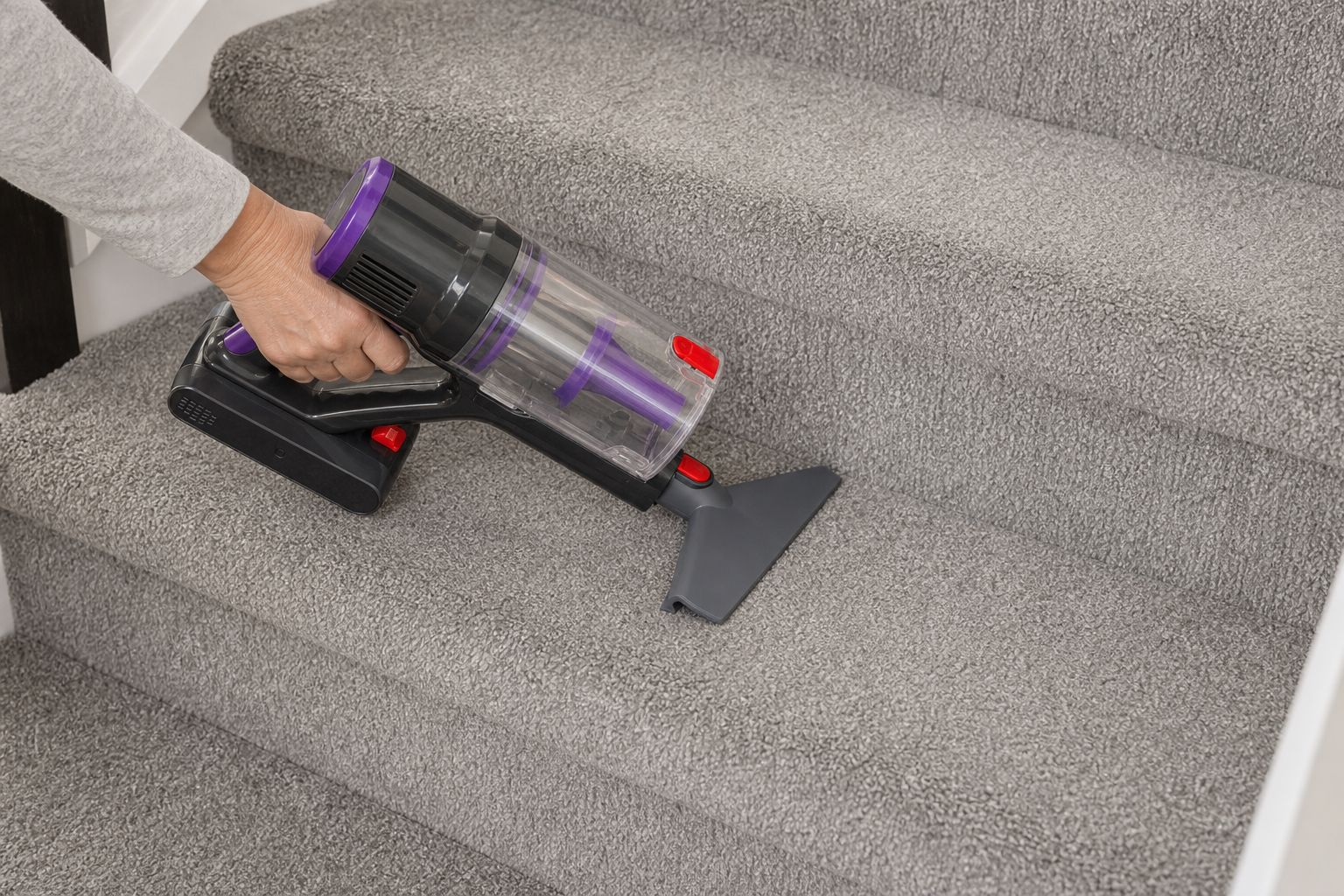 Keep the nozzle flat and clean one tread at a time with short, controlled passes.
5. Clean the Edges and Riser Carefully
Dust and hair often collect along the side trim and in the seam where the tread meets the riser. Use a suitable crevice tool for these narrow areas, guiding the tip along the corner without pressing it into the carpet or painted surface.
The vertical riser may need only a light pass with an appropriate tool. Keep the main vacuum body close to you rather than allowing its weight to pull the nozzle across the stair.
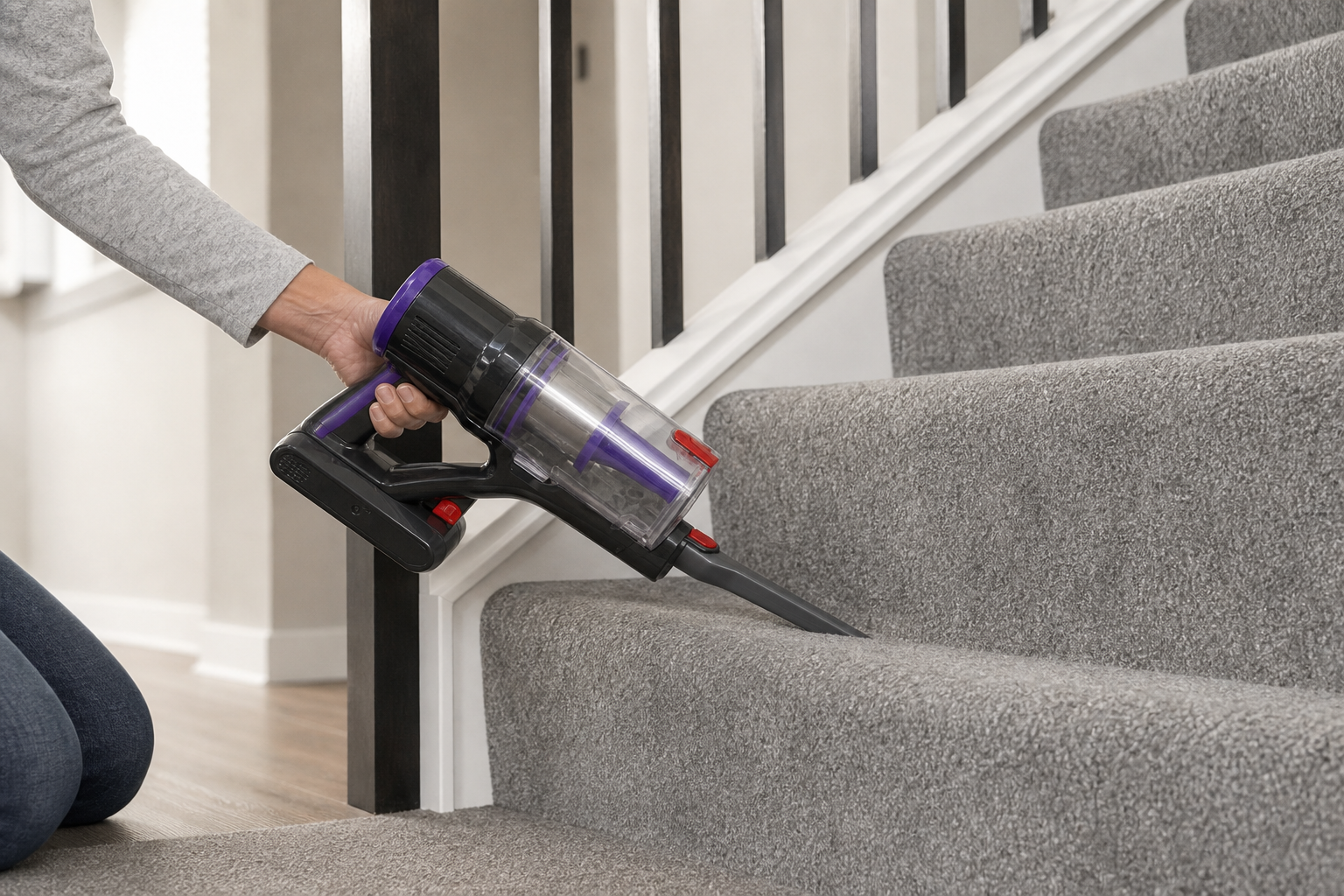 A narrow crevice nozzle can help reach the seam where the tread meets the riser and side trim.
6. Keep Attachments and Parts off the Steps
Place unused attachments on a landing or in a container beside the staircase. Do not leave them on a tread where you might step on them or knock them down the stairs.
A full-length tube or floor head should also remain on a stable level surface when it is not in use. Never lean a vacuum against the handrail and assume it will stay in place.
7. Check Each Section Before Moving
Look over the cleaned steps in good light before changing position. If one corner still needs attention, finish it while you are stable rather than returning from an uncomfortable angle later.
When you are finished, move the vacuum and attachments clear of the staircase before allowing normal foot traffic to resume.
How to Vacuum Carpeted Stairs
A broad upholstery-style nozzle can cover the centre of a carpeted tread more evenly than a narrow crevice tool. Use slow, overlapping passes and give extra attention to the front edge, where hair and grit can collect.
For fitted carpet, guide the tool along the surface without pulling at the seam. Loop-pile, wool and delicate stair carpets may have specific restrictions, so check the carpet maker's advice before using a powered brush or stiff bristles.
If the carpet begins to lift, bunch or catch on the attachment, stop and change the setting or tool rather than forcing the vacuum forward.
How to Vacuum Hard Stairs
On wood, laminate, vinyl, tile or stone stairs, pick up sharp grit and larger fragments before vacuuming. Check the attachment for trapped particles that could be dragged across the finish.
Use a suitable clean attachment with light pressure and keep the surface dry. Follow the flooring manufacturer's guidance, especially for sealed timber, natural stone or delicate finishes.
A small brush tool may help with dry dust along an edge if both the tool and surface instructions allow it. Do not use a dry-only vacuum on wet spills or damp debris.
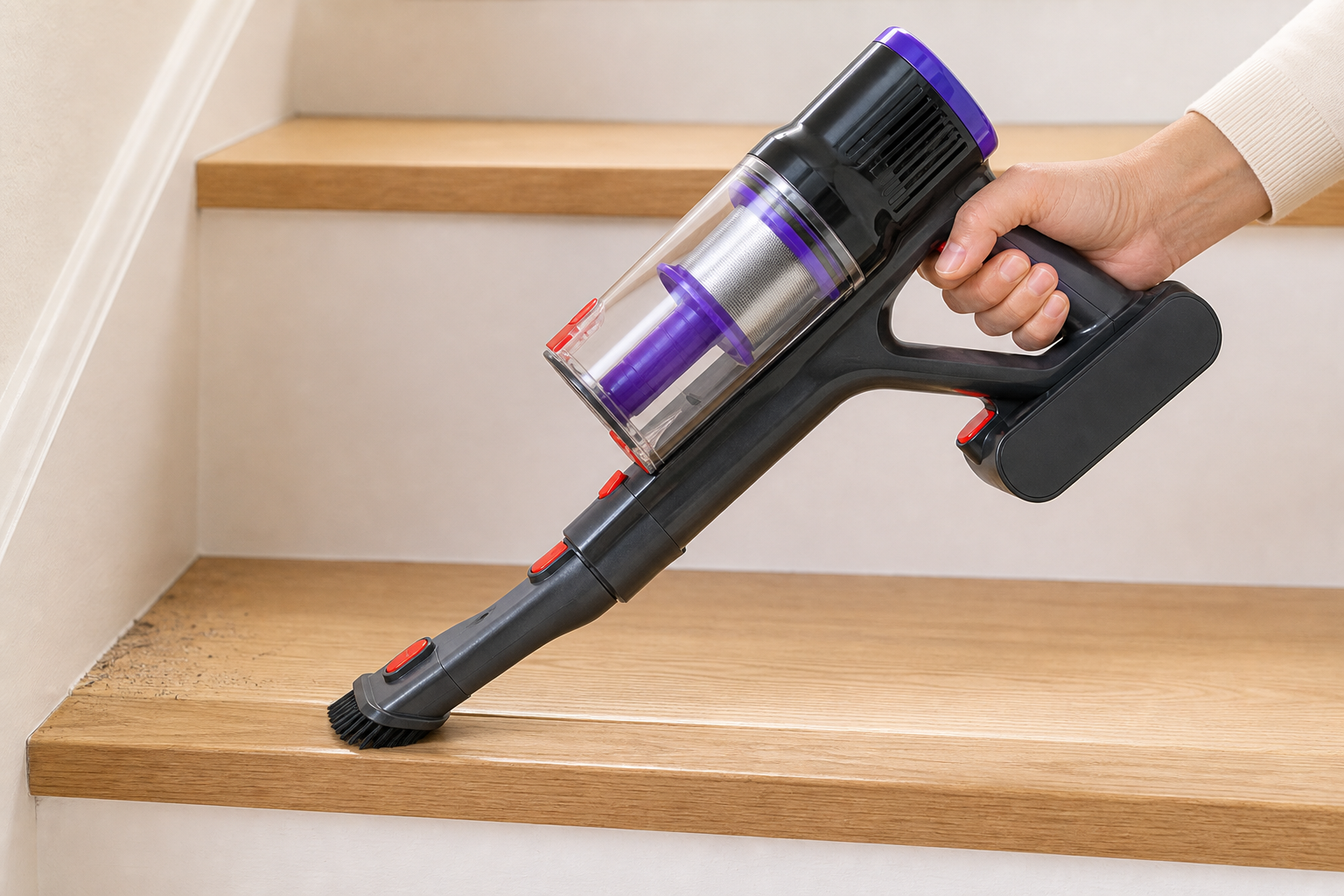 On a suitable dry surface, a small brush tool can lift dust from narrow stair edges without heavy pressure.
Common Stair Vacuuming Mistakes
Leaving shoes, cables or spare attachments on the steps
Trying to clean several treads without changing position
Balancing the vacuum body or floor head on a stair edge
Holding the main unit by the dust cup instead of the handle
Using a nozzle that is too wide to sit flat on the tread
Forcing a powered brush across delicate carpet or hard flooring
Ignoring a loose runner, damaged trim or damp stair
Vacuuming while another person or pet is trying to use the staircase
Using a Cordless Vacuum on Stairs
A cordless vacuum removes the need to manage a cable across the stairs, but the weight and shape still matter. A handheld configuration can keep the main unit close to your body and make it easier to use a narrow attachment in corners.
Before you begin, make sure the battery is secure and choose a power level appropriate for the debris. Stronger power is not automatically safer or more effective, particularly if it makes a fabric surface lift or the tool harder to control.
SIXPAD S80 Stair-Cleaning Tips
For close stair work, the SIXPAD S80 can be used without the aluminium tube when a suitable supplied attachment is fitted directly to the handheld unit. Hold the triangular handle and keep the rear battery, dust cup and chosen nozzle securely attached.
A broad grey nozzle can help cover suitable carpeted treads, while the long crevice nozzle can reach along edges and the seam between the tread and riser. The two-in-one brush may be useful for light dry dust on suitable surfaces. Always match the attachment to the material and follow the product and flooring instructions.
Do not rest the S80 on a narrow stair edge, carry it by the transparent dust cup or use it on wet debris.
How Often Should You Vacuum Stairs?
The right schedule depends on foot traffic, pets, outdoor access and how quickly dust becomes visible. Stairs near an entrance may need a light clean several times a week, while a quieter staircase may need less frequent attention.
Regular light cleaning can be easier than waiting for hair and grit to build up along every edge. Focus on the busiest treads and corners rather than following a rigid timetable that does not suit your home.
Final Thoughts
The best way to vacuum stairs safely is to make the task smaller: clear the route, use a manageable configuration, clean one tread at a time and move before you need to stretch.
A handheld vacuum and suitable attachment can make close work more practical, but stable footing and surface care remain the priorities. Stop whenever the position, equipment or staircase does not feel secure.